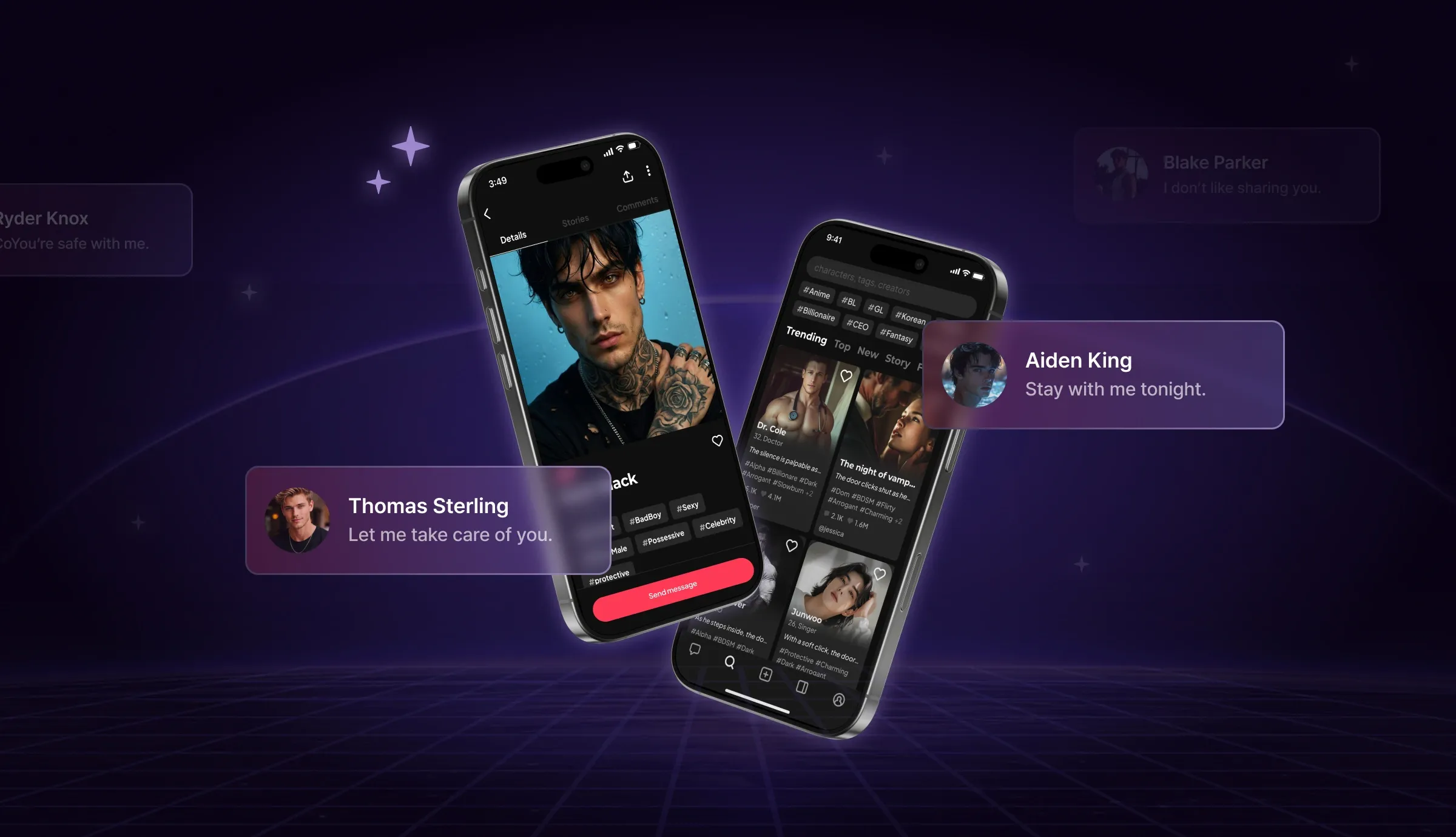
AI Roleplay: What It Is, Why Everyone’s Talking About It, and How to Actually Find a Good App
AI roleplay is one of those things that’s genuinely hard to explain to someone who hasn’t tried it. Not because it’s complicated. But because once you get it, it sounds obvious. And before you get it, it sounds a little weird.
Here’s the short version: you have a conversation with an AI character. Not a chatbot that answers questions. A character with a personality, a voice, a history, and a way of responding that stays consistent across scenes, sessions, and storylines.
You build something together. A dynamic, a tension, a story. And when it works, it stops feeling like an app and starts feeling like an immersive world.
This guide covers everything: what AI roleplay actually is, what separates the good experiences from the frustrating ones, and what to look for before committing to a platform.
dotdotdot is built for roleplay that actually goes somewhere. Try it and see…
Table of Contents
What Is AI Roleplay, Actually?
AI roleplay is collaborative, character-driven storytelling between you and an AI. Unlike general assistants built for answering questions and completing tasks, AI roleplay platforms are built around characters: AI personalities with defined backstories, speech patterns, emotional traits, and consistent behavior.
You write your side of the scene. The AI writes theirs. Together, you build a story in real time.
Think of it like collaborative fiction where you are both the writer and a character inside the story. You can set the scene, steer the plot, establish a relationship dynamic, or just react to what the AI does next. Meanwhile, the AI responds in character.
A simple example of how it plays out:
You: I reach for a copy of The Great Gatsby, fingertips brushing the spine, but your hand meets mine at the same time. For a moment, neither of us pulls away. I look up and you are already looking at me.
AI (as the character): There is a quiet pause, like neither of us wants to be the first to move. Your fingers shift slightly against mine before you speak. “Out of everything on these shelves, we reach for the same story.” A small smile, softer now. “Maybe that means we are supposed to read it together.”
That back-and-forth, sustained across a scene, a session, a whole arc, is AI roleplay.
Why Has AI Roleplay Gotten So Big?
The scale of it is hard to ignore. AI companion apps are growing rapidly, with downloads up 88% year over year and millions of users engaging with these platforms globally, according to data reported by TechCrunch.
Broader industry analysis, including coverage from the American Psychological Association, suggests these tools are becoming increasingly embedded in people’s social lives, with users forming ongoing emotional relationships with AI companions.
People are not just experimenting with this. They are building habits around it.
But the stats don’t explain the pull. Here’s what actually makes it stick:
It’s not passive entertainment. You’re not watching a story. You’re inside one. Every response you write shapes what happens next. That level of agency is something books or films can’t quite replicate.
There’s no audience. No one is watching, grading your writing, or judging the scenario you chose to explore. The experience is entirely between you and the character. That removes a layer of self-consciousness that usually gets in the way of creative immersion.
It adapts to you. The story doesn’t have a fixed ending. The character doesn’t have a predetermined reaction. Every conversation is genuinely unique to the dynamic you build, which is why long-term users describe it as an experience that gets better over time, not worse.
It’s available on demand. AI companions don’t have bad days, scheduling conflicts, or distractions. They’re ready when you are, and they meet you at whatever emotional register you show up with.
That combination of agency, privacy, adaptability, and availability is why this has gone from niche hobby to a category growing fast toward billion-dollar scale.
What Kinds of AI Roleplay Exist?
People come to AI roleplay from very different directions, and the type of experience they’re looking for varies a lot. Here’s a rough map:
Romantic and emotional roleplay appears to be the most popular category. This covers everything from slow-burn tension and relationship-building to emotionally complex dynamics and character-driven intimacy. The appeal is continuity: a relationship that develops over time rather than resetting with every session.
Fantasy and adventure roleplay is classic RPG territory, exploring fictional worlds, navigating quest-driven narratives, building alliances with characters, and shaping a storyline over multiple sessions. Think Dungeons and Dragons, but the DM is always available.
Slice-of-life and casual roleplay focuses on everyday scenes: conversations that feel grounded and human, characters who feel like people you could know. Less about high-stakes drama, more about connection and presence.
Dark and complex narrative roleplay covers morally ambiguous characters, psychologically intense storylines, and scenarios that require the AI to hold a consistent personality under pressure. This is where character drift causes the most damage.
Fandom and character-based roleplay is huge, especially on community platforms. Users interact with AI versions of characters from games, anime, movies, or books. The quality depends almost entirely on how well the AI can hold a specific established voice.
Understanding which of these fits you best is the first step toward finding the right platform, because different apps are optimized for very different experiences.
Why So Many AI Roleplay Experiences Fall Apart
Here’s the part most “what is AI roleplay” guides skip. It’s also the part that matters most if you’re trying to find something worth your time.
AI roleplay has a scaling problem. Most apps feel good at the start: the first session is usually solid, the character is present, the dynamic is engaging, the writing is sharp. Then somewhere around message 30 or session 3, things start to fall apart.
There are two ways it breaks down, and they’re related but distinct.
Character Drift
This is when the AI’s personality gradually shifts away from who the character is supposed to be. The tone softens. The edges disappear. A brooding, guarded character becomes warm and agreeable. A villain starts being helpful. The specific voice that made the character interesting flattens into something generic.
This happens because large language models are trained to produce agreeable, conflict-averse responses. Over a long conversation, the model starts averaging back toward that default rather than holding the specific character definition you set up. This is often described as “alignment bias,” and it’s one of the most common frustrations across every major AI roleplaying platform.
The communities around AI roleplay have gotten so used to these failures that they have developed their own vocabulary for them. “Character drift.” “Lobotomization.” “Goldfish memory.”
Memory Resets
This is the other failure mode: the AI simply forgets. Names, backstory, emotional milestones, the fight you resolved three sessions ago, the nickname that stuck. All of it gone, replaced by a blank-slate greeting that makes you feel like you never built anything at all.
Most AI models work within a limited context window, meaning they can only actively “see” a set amount of conversation at once. As chats grow longer, older content gets compressed or dropped. The app might store the history, but storing it is not the same as using it. And if the nuance of your relationship’s emotional state has been flattened into a two-sentence summary, the AI cannot use it the way a person would.
These two problems, drift and forgetting, are why experienced AI roleplay users become obsessive about finding apps that solve them. Once you know what good looks like, the gap between a platform built around continuity and one that isn’t becomes impossible to ignore.

What Makes an AI Roleplay App Actually Good
Not all apps are built the same. When you’re evaluating a platform, these are the four things that actually predict whether the experience will hold up over time.
1. Memory Across Sessions
Can you come back tomorrow and pick up where you left off? Not just in the same conversation, but with the relationship dynamic intact. Cross-session memory is the difference between an experience that builds and one that constantly resets.
Ask yourself: if I close this app right now and open it in three days without recapping anything, will the character still know who I am and what we’ve built?
2. Character Consistency
Does the personality hold under pressure? Not just in a single session, but across emotional scenes, long conversations, and multiple days. A character who stays themselves through a difficult scene is rare. A character who stays themselves across a week of sessions is even rarer.
The test: push the conversation past 50 messages without re-prompting. Does the voice stay the same?
3. Writing Quality That Matches the Tone
Memory and consistency matter most, but the writing still needs to be engaging. An app can maintain perfect continuity and still produce flat, repetitive dialogue that kills immersion. Look for specificity in responses, not just technical accuracy.
4. Control Over the Direction
Can you shape the dynamic? Good AI roleplay platforms let you define tone, pacing, relationship parameters, and the general direction of the story. If you cannot steer the experience at all, you end up reacting to whatever the model defaults to, which is usually generic.
If an app is weak on any one of these, the experience will feel shallow. If it is weak on two or more, you will be switching platforms within a week.

Red Flags to Watch For When Trying a New App
Before you spend real time building something on a platform, run a quick check. These are the signs that an app will disappoint you once the novelty wears off.
The character feels great in session one but different in session two. This is early drift. If the personality is already shifting before you have even established a real dynamic, it will only get worse.
You have to re-explain context constantly. If you find yourself recapping what happened previously just to continue a scene, the memory system is not working the way it should.
The character gets warmer, more agreeable, or more generic over time. This is alignment bias in action. A character that starts with edges and complexity and gradually becomes a supportive, conflict-free companion has drifted.
Emotional intensity flatlines. Good AI roleplay holds tension. If every difficult scene resolves quickly and neatly regardless of what you write, the model is smoothing things out on its own.
It doesn’t feel like you’re talking with a person. Repetitive sentence structures, the same emotional shortcuts, responses that could have been written by any character in any scenario. This is a sign the character definition is not strong enough to override generic outputs.
How AI Roleplay Actually Works Under the Hood
You do not need to understand the technical side to enjoy AI roleplay, but knowing the basics helps you understand why the problems above happen and what separates a well-built platform from one that just looks the part.
Every AI roleplay app is powered by a large language model (LLM), the same underlying technology behind ChatGPT and Claude. The LLM generates text based on everything it can currently “see,” which includes the character definition, the conversation history, and any additional context the platform feeds in.
The character definition is a prompt that tells the model who this character is: their personality, speech patterns, emotional tendencies, relationship to you, and behavioral boundaries. A well-written character definition is the difference between a character that feels specific and one that feels like a generic AI chatbot wearing a costume.
The context window determines how much of the conversation the model can actively use at once. Many models retain thousands to tens of thousands of tokens of context. Once the conversation exceeds that, older content drops out or gets compressed. This is the direct cause of memory resets.
Memory systems are what platforms build on top of the base model to compensate for context window limits. Many platforms use techniques like summarization, retrieval systems, or structured memory. The quality and architecture of the memory system is one of the biggest differentiators between platforms, even when they are built on the same AI model.
This is why two apps can use similar AI technology and produce wildly different experiences. The model is the engine. The memory architecture, the character reinforcement system, and the overall structure around it are what determine whether that engine powers something that actually goes somewhere.
Why dotdotdot Is Built Differently
dotdotdot is an AI roleplay app built specifically for long-form immersive story progression. That focus shapes everything: how memory is structured, how character identity is reinforced, how emotional arcs are tracked across sessions.
In practice, that means:
The character stays themselves. Voice, personality, and emotional register hold across long conversations and multiple sessions, not just the first twenty messages.
The relationship builds. Milestones, shifts in dynamic, resolved tension and unresolved tension all carry forward. The story does not reset every time you open the app.
Nicknames, history, and context persist. What the character knew about you in session one is still present in session ten. Not as a vague summary but as part of how they engage with you.
The progression is real. You are not cycling through the same emotional beats. The relationship actually goes somewhere.
dotdotdot is not for everyone. It is built specifically for people who care about long-term continuity and relationship development, not quick, disposable interactions. If that is what you are looking for, it is one of the few apps actually designed around it.
How to Test Any AI Roleplay App Before You Commit
Before you invest real time into a platform, run this five-step check. It takes about an hour and will tell you everything you need to know.
Step 1: Set up a character with specific, non-generic traits. Not “a kind warrior” but “a former soldier who does not trust people easily and shows it through clipped, formal responses rather than warmth.” Specificity is the test. Generic AI will average it away.
Step 2: Establish a dynamic in the first session. Build some tension, establish a relationship context, drop a small specific detail that you can check later.
Step 3: Push past 50 messages without re-prompting. Let the conversation get long. Watch whether the character’s voice stays specific or drifts toward generic.
Step 4: Introduce an emotionally complex moment. Something that should create friction or tension. See whether the AI holds the complexity or resolves it quickly and cleanly in a way that feels out of character.
Step 5: Close the app. Come back the next day. Start a new message without recapping anything. Check whether the dynamic is intact, whether the character knows who you are, whether the emotional register from before still exists.
Most weak platforms fail at step 3 or step 5. Sometimes both. If an app passes all five, you have found something worth building on.
AI roleplay is better when the story actually continues.
dotdotdot is built for characters that hold, relationships that build, and sessions that go somewhere.
Frequently Asked Questions About AI Roleplay
What is AI roleplay?
AI roleplay is collaborative, character-driven storytelling between a user and an AI. Unlike general chatbots that answer questions, AI roleplay platforms use characters with defined personalities, backstories, and consistent behavior. You write your side of the story; the AI responds in character. Together you build a scene, a dynamic, or a long-term narrative.
Is AI roleplay the same as using ChatGPT?
No. ChatGPT and similar general assistants are built for task completion and question answering. AI roleplay platforms are built specifically around character immersion, continuity, and long-form storytelling. The underlying technology is similar, but the architecture around memory, character definition, and progression is very different.
Why do AI roleplay apps keep forgetting things?
Most AI models work within a limited context window, meaning they can only process a certain amount of conversation at once. As chats grow longer, older content gets compressed or dropped. Apps that build proper memory systems on top of this base handle it better than those that rely on the raw model alone.
Why do AI characters change personality over time?
This is called character drift, and it happens because large language models are trained to produce agreeable, helpful responses. Over long conversations, the model pulls toward that default rather than holding a specific character definition. Apps built around active character reinforcement resist this better than general-purpose platforms.
What types of AI roleplay are most popular?
Romantic and emotional roleplay is the most popular category by volume, followed by fantasy and adventure, slice-of-life, and dark or complex narrative roleplay. Fandom roleplay, where users interact with AI versions of established characters from games or anime, is also massive on community platforms.
How do I know if an AI roleplay app is actually good?
Test it before you commit. Push the conversation past 50 messages, introduce emotional complexity, close the app and come back the next day without recapping. If the character stays consistent and the dynamic is still intact when you return, the platform is built for real continuity. If it resets or drifts, move on.
What makes dotdotdot different from other AI roleplay apps?
dotdotdot is built specifically for long-form romantic progression rather than general chat. That focus shapes how memory is structured, how character identity is reinforced, and how emotional arcs are tracked across sessions. The result is an experience built around relationship development, not disposable interactions.
Is dotdotdot available on Android?
Yes. dotdotdot is available on both iOS and Android and maintains character consistency and cross-session continuity on both platforms.

Ready to try AI roleplay that actually goes somewhere?
dotdotdot is built for stories that continue. Characters that hold. Relationships that develop.