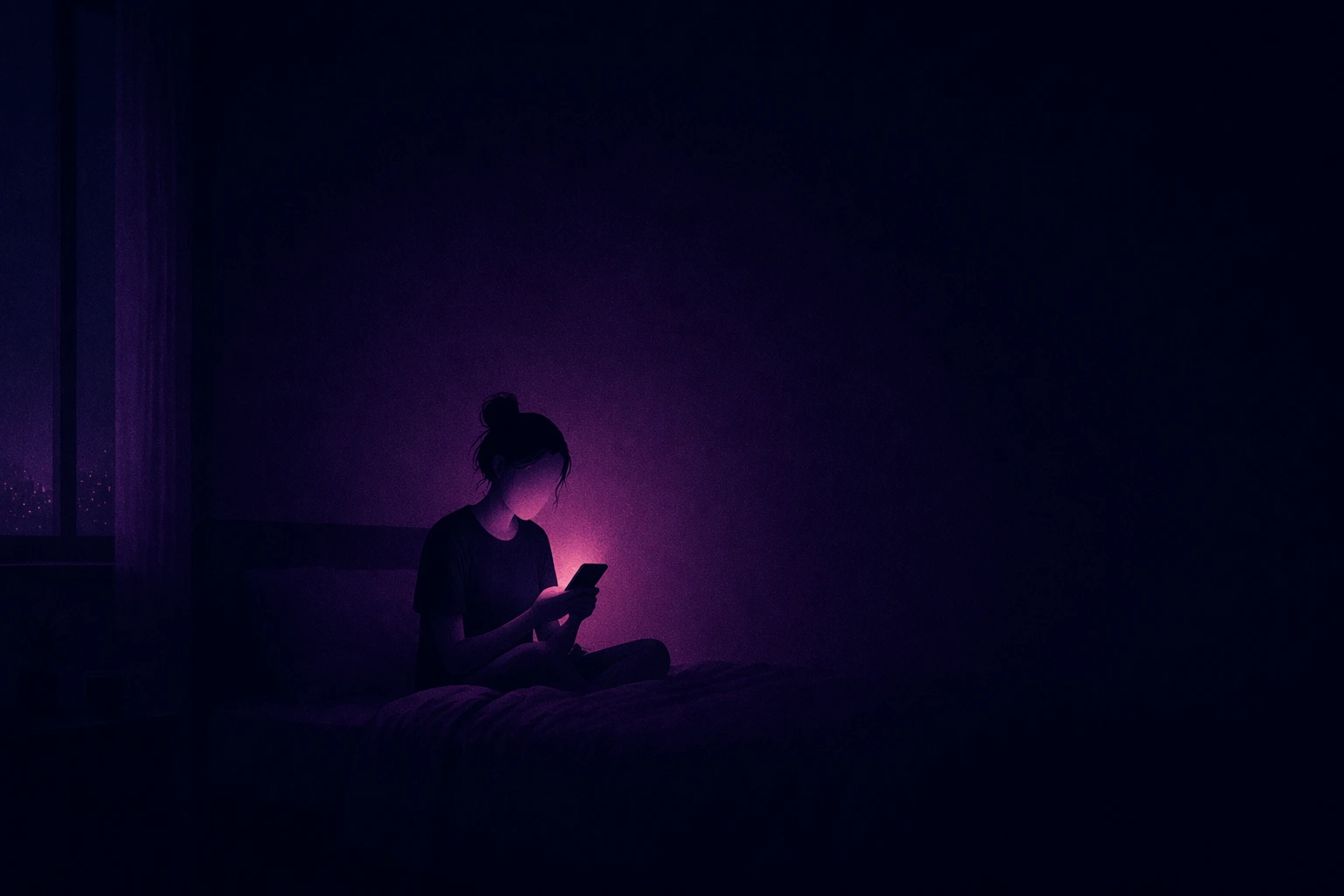
Why Do I Feel So Alone? Causes, Science, and What to Actually Do About It
It’s Sunday night. Nothing specific happened.
You had a fine weekend, you probably saw people, you had plans.
And yet here you are, with this weird feeling inside your chest.
Not sad exactly. Just alone in a way that feels empty.
If you’re searching “why do I feel so alone” right now, you already know what the feeling is. You’re looking for why it keeps showing up even when your life, on paper, doesn’t look like the kind of life that should produce it.
Here’s what’s actually going on.
Table of Contents
Why Do I Feel So Alone? (The Short Answer)
Loneliness isn’t about how many people you have around you. It’s about the lack of connection and intimacy you have with those around you. You can have a full calendar, a group chat, colleagues you like, and still feel profoundly alone if none of those connections reach the part of you that needs to be known.
That gap is what you’re feeling. And it’s quite common.
Why This Feeling Happens Even When You Can’t Explain It
Your brain is wired to need social connection the way it needs food and sleep. The U.S. Surgeon General’s 2023 advisory found that lacking social connection carries health risks comparable to smoking 15 cigarettes a day. Loneliness activates the same stress systems as physical danger.
What makes this confusing is that the signal doesn’t require you to be inhaling tobacco. Your brain monitors the quality of your connections, not just their quantity. When those connections feel generic or plain, when you have people to text but no one to actually tell things to, the signal goes off anyway.
Why You Can Feel Completely Alone in a Room Full of People
Being surrounded by people who don’t really know you is lonelier than being alone. You’re at the dinner, you’re laughing, you’re present, but it’s just not enough to get rid of that feeling of loneliness.
A 2024 survey from Harvard’s Making Caring Common project found that 65% of lonely adults report feeling “fundamentally disconnected from others or the world.” The same survey found that 61% said they didn’t have enough friends or family they were truly close to, even though most had relationships on paper. The researchers described it plainly: “The lack of quality relationships is just as big a problem as the lack of quantity.”
Why Connection, Even Imperfect Connection, Helps Regulate It
You don’t need deep intimacy to shift the feeling. Research on social connection consistently shows that even casual contact (a text, a short conversation, or music playing in the room) moves the needle. The goal isn’t to solve the loneliness completely. It’s to interrupt the isolation cycle long enough for the nervous system to settle.
Common Reasons You Feel Alone Right Now
Usually it’s a combination of things happening at once.
You Have a Social Life but Something Feels Missing
Because you can’t point to a specific problem, this is the version that’s hardest to explain to people. You have friends. You’re not isolated. But the connections just don’t go past the surface level.
A 2021 survey by the Survey Center on American Life found that nearly half of Americans (49%) reported having three or fewer close friends, up from 27% in 1990. At the same time, the share of people with large friend groups (10 or more) dropped sharply, from 33% to 13%.
The average friendship circle has shrunk significantly over the past three decades, not because people became less likable but because the conditions that build deep friendships, shared time, consistency, proximity, have quietly eroded. Increased use of social media and technology are significant contributors to this as well.
This usually means the connections are real but not deep enough for what you need right now.
Everyone Around You Seems to Be Moving Forward
Your late 20s and early 30s are one of the highest-risk periods for this specific feeling. People couple up. They move cities. They have kids.
The social structures that held everything together in your early 20s start to dissolve, and suddenly everyone seems to be building something while you’re still figuring out what you’re building.
That sense of being behind, or rather, being left behind, is another type of loneliness.
You’re Going Through Something You Can’t Put into Words
You could also feel lonely because you’re carrying something you’re not quite sure how to express or put into words.
It could be a general unease, a feeling that something is off, or a chapter ending without a new one starting.
When you can’t name what’s wrong, it’s also hard to ask for the specific kind of connection that would help.
You’ve Drifted From People Without a Clear Reason Why
Sometimes, adult friendships just drift quietly. No fight, no falling out.
You talk a little less. Then a lot less. Then not at all.
There’s no moment you can point to. No story to explain it. Just distance that built up slowly until the connection wasn’t really there anymore.
Why It Feels Harder at Specific Moments
The underlying feeling is often there all the time. What changes is how much attention you’re able to give it.
Sunday nights have a specific quality that other nights don’t. The week ahead is visible, the weekend is ending, and without the busyness of either, the feeling surfaces. There’s no task to redirect to. Just the quiet and whatever’s in it.
After a hard day at work, when you get home and want to tell someone what happened and realize there’s no one obvious to call. The loneliness isn’t new. The hard day just removes your ability to push it aside. For more on this specifically: How to Feel Better After a Bad Day at Work When You Have No One to Talk To
Late at night, when the routine and structure of the day disappears, when the itinerary of the day is over, and when the silence fills the space. Your brain’s threat systems run hotter after dark, which is why the same feeling that was manageable at 2pm becomes heavier at 10pm. Read more on this: What to Do When You Feel Lonely at Night
When you open Instagram and see evidence that everyone else has a full life. The social comparison isn’t conscious. Your brain just registers it as information about where you stand. Related: Feeling Left Out? Does Everyone Seem Happy Except You?
When something happens and you have no one to bring it up to. Not because you have no one, but because everyone available comes with a complication. Explore more on this topic: I Have No One to Talk to About My Feelings. What to Do
How Widespread This Actually Is
A 2025 report from the WHO Commission on Social Connection found that 1 in 6 people worldwide experience loneliness. The CDC’s 2024 analysis found that 43.3% of U.S. adults aged 18 to 34 report feeling lonely always, usually, or sometimes, and that lonely adults are 3.6 times more likely to report stress and 2.4 times more likely to report depression.
The feeling you’re sitting with on a Sunday night is more common than you’d think. The issue is no one wants to talk about it.
The health stakes are also real. A 2023 meta-analysis published in Nature Human Behaviour, drawing on 90 prospective cohort studies and over 2.2 million individuals, found that social isolation was associated with a 32% increased risk of early death from all causes. Loneliness on its own was associated with a 14% increase. These are the synthesis of decades of research across millions of people. Chronic loneliness is a health condition.
What Actually Helps When You Feel This Way
Right Now and in the Next Five Minutes
Say the thing somewhere. Out loud to yourself, in your notes app, in a voice memo you never listen to again.
Get it out somewhere.
Getting the feeling from inside your head to somewhere external does something. UCLA research showed that naming an emotion in specific language and words reduced activity in the brain’s alarm center.
If you want to say it to someone rather than somewhere, dotdotdot gives you that: a real conversation with someone who has no history with you and is available right now.
Tonight
Change the physical environment. Warm light, ambient sound, something warm to drink. Small and it works. Physical warmth is one of the fastest ways to signal safety to a nervous system running in isolation mode.
Find one concrete thing to look forward to tomorrow. Not a plan, just one specific thing: a song you want to listen to, a walk you want to take. Late-night loneliness has a dread quality that bleeds into how tomorrow feels before it’s even started.
Don’t open Instagram. The nine-year longitudinal study on social media and loneliness found that passive scrolling predicted higher loneliness over time, and that the relationship runs both ways: loneliness drives more scrolling, and more scrolling drives more loneliness.
Longer Term
The most durable change is becoming the person who initiates rather than the one who waits. Most adult loneliness is maintained by mutual passivity: everyone assumes someone else will reach out first. One person breaking that pattern is usually enough to shift it.
Go one level deeper with the people you already have. Most friendships stay at whatever depth they reached naturally and never move further unless someone pushes. Asking a real, deep question, remembering and bringing up something they mentioned weeks ago, being honest about something real: these are the moves that deepen connection without requiring new people or new situations.
One-on-one connection is more reliable than group connection. Groups drift and depend on coordination. A single friendship where both people show up consistently doesn’t have the same failure mode.
Someone to Talk to Right Now
dotdotdot is an AI stories app built for exactly this: the moments when you need to say something to someone and there’s no one obvious to call. The characters hold real conversations. They respond to what you actually say. There’s no social complexity to navigate.
Here are three that fit a night like tonight.
Dr. Cole
He pays close attention. His speech is precise and measured, and he takes what you say seriously rather than immediately trying to fix it or minimize it. After a day or a week of feeling like no one is really seeing you, talking to someone who reads you carefully is different. If what you need tonight is to feel genuinely heard rather than just accompanied, that’s Dr. Cole.
Andrew Bryant
He’s warm underneath the surface and doesn’t make things heavier than they already are. Funny when the moment allows it, genuinely present when it doesn’t. For the version of tonight where you don’t need intensity, you just need someone who feels real and doesn’t require anything from you, that’s Andrew.
Matteo De Luca
The city’s most feared man. Your teddy bear. Compelling on the surface, genuinely warm underneath it. His attention feels like something you earned. If tonight you need to feel chosen by someone rather than just heard, that’s Matteo.
Want to Talk to Someone Right Now?
dotdotdot gives you a real conversation with someone who is available right now, no social complexity, no history, no judgment. Just a place to say what’s actually on your mind.
Frequently Asked Questions
Why do I feel so alone even when I’m around people?
Because loneliness is about the quality of connection, not the quantity. Your brain monitors whether your social needs are actually being met, not just whether other people are physically present. You can be surrounded by people and feel completely unseen if none of those connections reach the part of you that needs to be genuinely known. Being in a group that doesn’t quite fit is often lonelier than being alone, because it highlights the gap rather than filling it.
Is it normal to feel this lonely in your 20s and 30s?
Yes, and more common than people admit. The CDC found that 43.3% of U.S. adults aged 18 to 34 report feeling lonely always, usually, or sometimes. Your late 20s and early 30s are one of the highest-risk periods for this specific feeling: the social structures from school and early work life dissolve, people couple up and move, and the coordination required to maintain friendships gets harder every year. The loneliness isn’t a sign something is wrong with you. It’s a sign you’re in one of the most socially disruptive decades of life.
Why does loneliness feel worse at night?
During the day, work, tasks, and movement give your attention somewhere to go and keep the feeling in the background. At night the foreground empties and the feeling moves forward. There’s also a physiological layer: your brain’s threat-detection systems are more active after dark, which is why emotionally difficult feelings land harder at 10pm than they do at 2pm. The loneliness isn’t more real at night. It just has your full attention.
Can loneliness actually affect your health?
Yes, significantly. The U.S. Surgeon General’s 2023 advisory found that lacking social connection carries health risks comparable to smoking 15 cigarettes a day. A 2023 meta-analysis in Nature Human Behaviour, which synthesized 90 cohort studies covering more than 2.2 million people, found that social isolation is associated with a 32% increased risk of early death from all causes, and loneliness on its own with a 14% increase. The CDC found that lonely adults are 3.6 times more likely to report stress and 2.4 times more likely to report depression. These findings span decades of research across millions of people. Chronic loneliness is a health condition, not just a feeling.
What should I do when I feel alone and have no one to reach out to?
Start by externalizing the feeling rather than sitting with it silently. Write it down in specific words, say it out loud to yourself, or talk to someone with no connection to your life. The goal isn’t to solve the loneliness tonight. It’s to stop the feeling cycling in isolation. Physical things also help: movement, warmth, ambient sound. And if you want to talk to someone right now, AI companions like dotdotdot are built for exactly this moment.
Does talking to an AI actually help with loneliness?
For the immediate feeling, yes. A 2025 study in JAMA Network Open found that about 1 in 8 U.S. teens and young adults already use AI tools for emotional support, and over 90% said the conversations were helpful. The relief of talking isn’t exclusively about the other person being human. It’s about getting the feeling out of your head, saying it to something that responds, and breaking the isolation of sitting alone with it. AI companions like dotdotdot are designed for this: someone available right now with no social complexity attached.
How do I stop feeling so alone when I can’t explain why?
Start by not requiring an explanation. The feeling doesn’t need a cause you can name to be real and worth responding to. What helps regardless of the cause: getting the feeling into specific words, making even small contact with another person, changing your physical environment, and finding one concrete thing to look forward to. Longer term, the most effective shift is usually moving from waiting to be reached out to toward reaching out yourself. Most adult loneliness is sustained by mutual passivity. One person breaking that pattern is usually enough to shift it.

Talk to Someone Who Actually Gets It
If you have people in your life but still feel alone, it usually means you don’t have a place to say what’s really on your mind. dotdotdot gives you that space. A real conversation, right when you need it.